

September 12th, 2001
My only cohesive memory of the first grade is the events of September 11th.
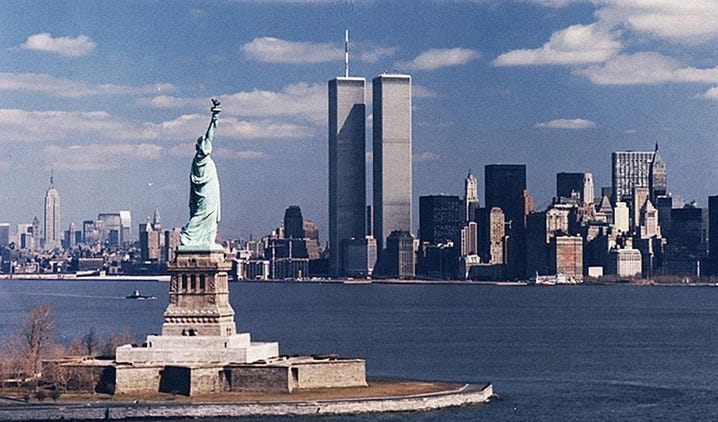
I was nary a week into the first grade when I returned home from school to the sound of the television. It was a curious oddity, as I recall my family being particularly strict with no TV after school. Then I saw why — one of the earliest images of my life, forever seared into my head at six years old: the sight of those harrowing towers of smoke, in place of those majestic structures that proudly stood.
The second image would come tomorrow, when a classmate brought a copy of that day’s The New York Times for our teacher, Ms. Occhiogrosso. I regret that my eyes wandered to the bottom of that front page, with its dire all-caps and italicized headline, to a woman smothered in blood and soot.
I regret that these images stand among my earliest memories.
Six years earlier, I was born in New York City. As an infant, my parents took me to Windows on the World in the North Tower, a moment I fervently wish was my paramount memory of the towers. But most of my childhood was spent in a halcyon, conservative town called Somers, an hour’s drive up Interstate 684. I am fortunate to have no memory of witnessing the collapse of the Twin Towers, and even more so to have not lost anyone in my immediate world that day.
Unfortunately, I knew someone who did. My classmate’s father, who served in the FDNY, was one of the 2,606 people to perish at the World Trade Center on that solemn day. May his courage and service to the FDNY, the City of New York, and our Nation live eternally in our memory.
I pray my classmate and their family are well. I pray the woman in The New York Times is well.
In spite of the potency of the memory of that day, I have no recollection of watching President Bush’s address to the Nation that night. In youthful rebellion I bucked the conservatism of my hometown to become a liberal; to this day I’ve been a lifelong Democrat. That speech by George Bush is the Republican speech I have studied and listened to the most. Though my life has been bereft of religion, forever are the words of Psalm 23 etched into my being — its sixth verse engraved into my paternal grandparents’ tombstone, and fourth spoken by the President on that evening:
Even though I walk through the valley of the shadow of death, I will fear no evil: for you are with me.
Fall 2003
It was around this time I learned my cousin and her husband were deploying to Afghanistan and Iraq, respectively.
My eight-year-old cerebral cortex too undeveloped, I didn’t know what this meant. What I remember are the late Peter Jennings, the nonstop broadcasts on the wars on ABC World Nightly News, and conspicuous absences from Thanksgiving and Christmas gatherings.
In adult life, I think of the lineage of war my family history is intertwined with. I ruminate on the early childhood of my paternal grandmother, who passed last year after her ninety-eight years on this Earth, and her youth in Japanese-colonized Korea. The thought of her learning of the atomic bombing of the Empire, later fleeing to the South from her native Pyongyang during the Korean War, perplexes as much as it fascinates me.
In my generation, war came home in a dual void. In one sense, the literal, physical void of my cousin ceasing to be a fixture at our holiday gatherings for years. In another, the void of what happened, the sense I had as a child that to inquire about war was improper, and the grave apprehension I had about ever broaching the question. Most of all, it is the deep quietness from my cousin’s husband that I remember, and my shyness in piercing it. A quietness not of introversion, but of having seen what most others have not.
We were blessed in that everyone came home from their deployment. For a myriad of reasons, it has been many years since I have spoken to that part of my family. Every September 11th, I am reminded of the life-changing decision they, and thousands of other young people in the aftermath of the terror, made for this country.
I think about the world then, children of immigrants from Queens, New York sent to the graveyard of empires by greater powers, to fight two wars that will be endlessly enshrined in disgrace as colossal foreign policy catastrophes. History is made magnificent in retrospect. But when it is lived and observed, it is people in our lives thrust into extraordinary situations. The Global War On Terror is not merely a grand narrative of the epochal decline of America’s international stature. It is also the memories with my cousin that could have been, but never happened.
I pray my cousin, her husband, and their children are well.
September 11th, 2025
Twenty-four years later.
I need not re-litigate, as many others have, that our society is suffering from a deep malaise. Nor do I wish to leave you on a dim note.
Instead, I want to convey the local history I love most about my home city: the stories of strangers who helped one another on September 11th. In the words, spirit, and charity of the late and great Fred Rogers, that giant of humanity among mortals: “look for the helpers.”
The best of New York, and indeed, the best of humanity was found in people like the friends of John Abruzzo, a quadriplegic, who collectively carried him down sixty-nine stories in Tower One on a combination sled and chair. Once they reached the lobby, Abruzzo’s friends carried him over scattered debris and glasses, finally escaping the collapsing tower. Even when FDNY firefighters offered to rescue Abruzzo on the tenth floor, his friends turned down the firefighters’ offer, pushing through to ensure their friend made it out of the North Tower safely. And escape, John Abruzzo did.
That same humanity was found in Moira Smith, the only woman NYPD officer to make the ultimate sacrifice on that day. Officer Smith, waving her flashlight, guided hundreds of people out of the towers to safety, urging people “Don’t look! Keep moving!”. From one account:
I came to the end of the ramp and I was standing squarely in front of Moira, I leaned to the left to try look past her to see the plaza. She quickly matched my motion and blocked my vision saying "don't look." Our eyes made direct contact. My eyes said to her, "I know how bad it is and I understand what you're doing." Her face was full of pain and her eyes said to me, "In this horrific situation, this is the best and only thing I can do.
Her heroism in keeping others calm and resolutely directing people before the tower’s collapse exemplifies the best of our city. God rest her spirit forever, and all those first responders who made the ultimate sacrifice.
I do not purport to have easy answers to our chronic malaise, to this vile pestilence of terroristic political violence, because there aren’t any. There will be many who peddle the farce of cheap ideology, and proffer vulgar simplisms and silver bullets to our social ailments.
Let me suggest at least a small action that will not make America whole in full, but we have the agency to make good on.
Today, on this twenty-fourth anniversary of that calamitous day, I hope we can begin to know camaraderie afresh. I yearn for the day that we all not only know, but feel in our core goodness and charity towards our neighbor. Don’t give up on the American people, and live knowing that even if our collective decency is temporarily forgotten, through willful service to each other, we can rekindle that sacred togetherness as a country again.
I pray that the American Republic is made well once more.
Very heartfelt and welcome. There's still an America out there, and if we work together, we can find it and bring this country and all its promise back!