

Hi readers: firstly, an apology for not keeping up with writing as much as I wanted to this year. In large part, this is because of several big life updates on my end:
In May, I joined the research staff of the Ocean Transport Group led by Professor Dhruv Balwada at the Lamont-Doherty Earth Observatory at Columbia University, where I’m working on machine learning techniques in physical (coastal) oceanography.
In July, I also joined the research team at the Center for New York City Affairs as a Budget and Economic Policy Analyst, where I am working on issues related to New York State and City fiscal policy.
I am now back teaching at Adelphi University, albeit with a smaller teaching load: one seminar course in Environmental Economics.
It’s an exciting time in my personal life and the world, and I’m hoping to be more galvanized in writing in the months to come. For this article and all others forthcoming, my opinions are strictly my own and are not representative of any of my employers.
Happy Climate Week, New York. Summer is now over. These months of 2025 will be historic for many reasons: from cultural apotheosis in the engagement of Taylor Swift and Travis Kelce, to the viral and kitsch like Honey Deuces at the US Open, culminating in outright turmoil from the bombing of Iran’s nuclear sites, the assassination of Charlie Kirk, to all else rocking US macropolitical stability.
It was also the second-hottest summer on record in my home city of New York. Oh, and the summer of Zohran Mamdani, the ascendent democratic socialist and near-certain mayor-to-be.
In my seven years of doing politics in New York, Mamdani’s victory is the pinnicle of surprise and awe. I was on AOC’s inaugural campaign in 2018 and am in some scenes of Knock Down the House. Later on when I went on to work for Assemblyman Ron Kim, my work in investigating nursing home improprieties during COVID would lead to my former boss’s feature in The New York Times, and the beginning of the end for Andrew Cuomo, New York’s long-reigning imperial governor. But none of my experiences compare to what I felt on Tuesday, June 24 this year — on that oppressive, sweltering day in excess of 100 degrees Fahrenheit — when I saw my old New York State Assembly colleague vault into the worldwide limelight.
I knew Zohran; not well enough to be the best of friends, but sufficiently so to be in each other’s contacts and for me to have received a fundraising call from him in January. (I couldn’t pick up — sorry, Mr. Mayor-to-be.) Here’s one attempt at returning the mayor-ascendant’s overture: with summer’s farewell, it’s time we discussed what in the fiery scorchers of hell happened with New York’s temperatures that felt like, well, a fiery scorcher from the pits of hell?
The Heat Dome
According to the National Weather Service Automated Surface Observing System (ASOS) station in Central Park, New York, the hottest day this summer was Tuesday, June 24, peaking at a maximum measurement of 99 degrees Fahrenheit. Coincidentally, June 24 was also the day of our city’s primary elections for mayor, city council, and other local offices. If you were street canvassing on that day, this is not merely a number — you felt it.
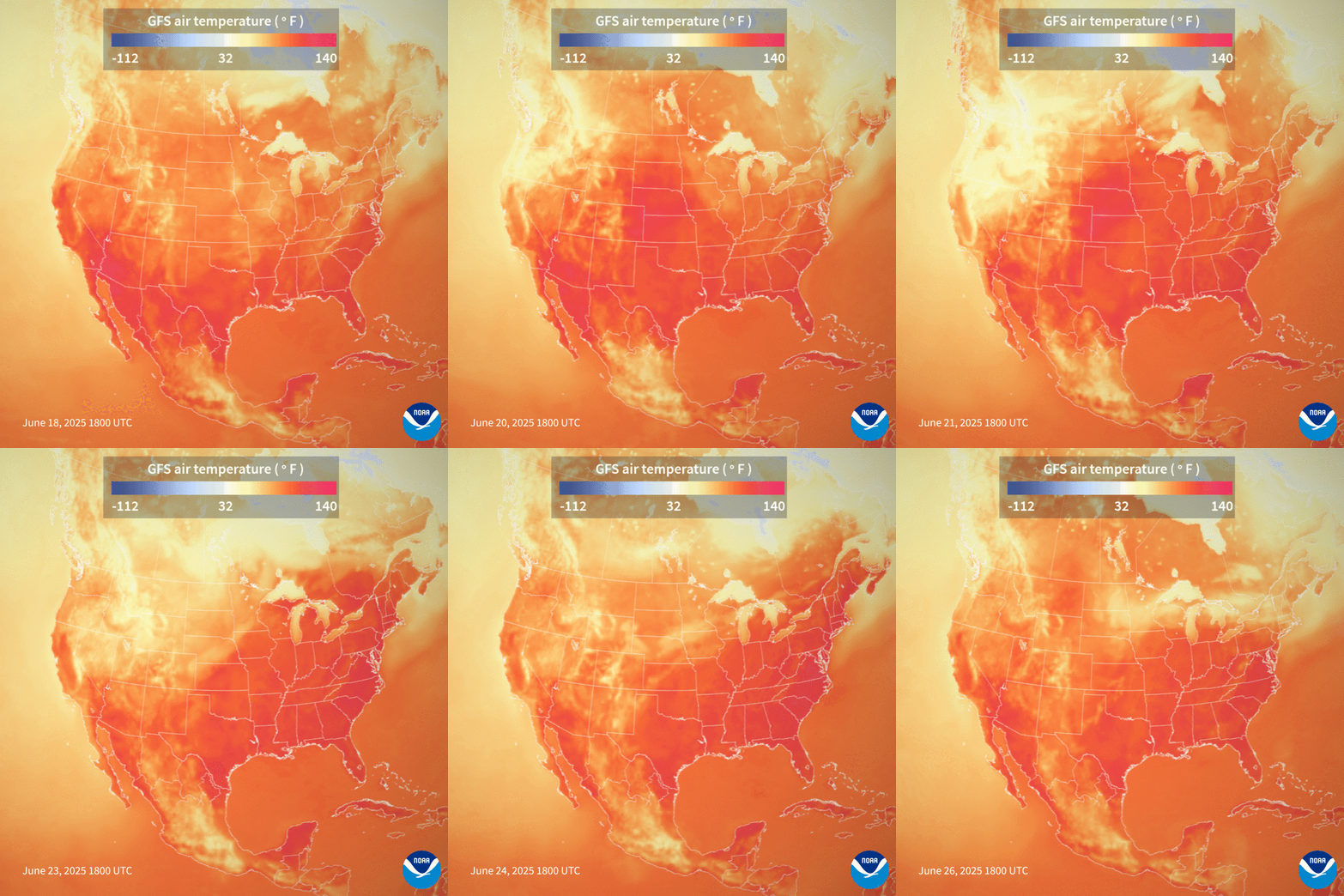
The culprit behind the brutal heat campaign volunteers (and just about everyone else) suffered that day? A heat dome.
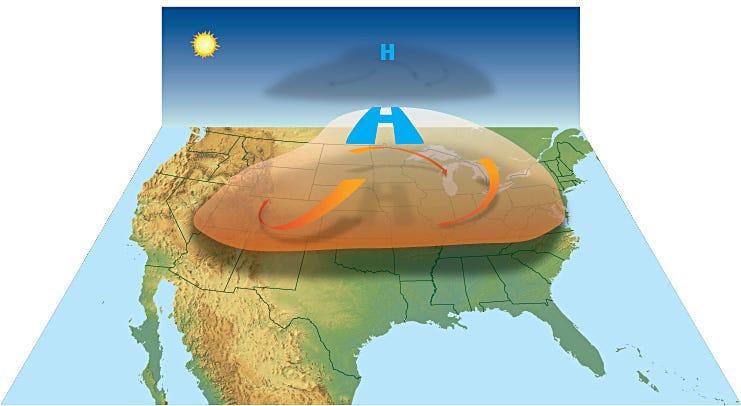
Imagine a bundle of hot air concentrated at the Earth’s surface and “trapped” by a “dome” placed all around it. That “dome” is high pressure from the atmosphere. This prevents the transfer of heat to the upper layers of the atmosphere, and consequently, cloud formation when that warm air cools down at higher altitudes. All of us unfortunate enough to be stuck in the heat dome roast under the blazing sun.
Extreme heat is the prime killer of all extreme weather events. Per NOAA, the annually-averaged deaths directly due to heat in the United States from 2013 to 2022 was 153. When we get local, we find that on average from 2018 to 2022, five individuals in New York City died directly from heat, while 520 more succumbed to heat-exacerbated deaths, in which extreme temperatures aggravated an underlying medical condition. This past summer saw a record number of single day emergency room visits due to extreme heat, the highest since 2019.
As a public health matter, New Yorkers should be appalled, and find this state of affairs unacceptable. What are we to do about it?
The First Line of Defense: New York City Emergency Management
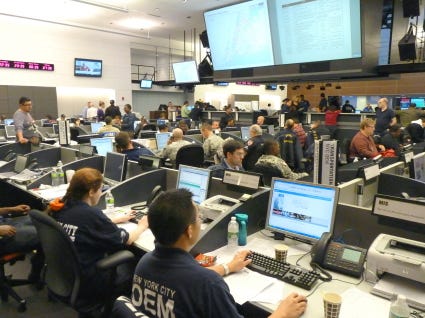
In catastrophic events, New York’s organizational apparatus for coordinating disaster response and relief efforts is New York City Emergency Management, or NYCEM (formerly the New York City Office of Emergency Management, or OEM). Its mandate (from the NYCEM website) is:
The agency is responsible for coordinating citywide emergency planning and response for all types and scales of emergencies. It is staffed by more than 200 dedicated professionals with diverse backgrounds and areas of expertise, including individuals assigned from other City agencies.
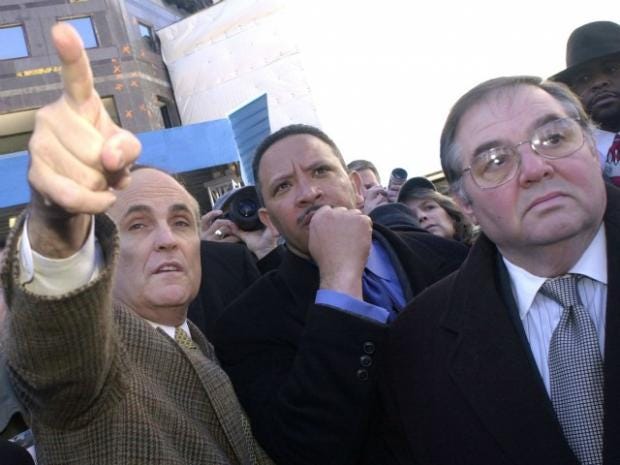
Many iterations of an emergency response agency existed throughout the city’s history, but the most recent incarnation is traced back to the administration of Mayor Rudolph Giuliani, who established the then-named OEM by executive fiat in 1996. The young OEM’s greatest test came on that dark day in September 2001, where its Director, the late Richard “Richie” J. Sheirer, shepherded the plethora of local, state, and federal agencies in the formidable task of rescue and recovery in the aftermath of the terrorist attacks. There are days of world history that test the fortitude and lifetime of experience in career bureaucrats trained in disaster response; September 11, 2001 was that day for Mr. Sheirer and all who served in OEM then.
In recent years, under Mayors Bloomberg and de Blasio, OEM operated at the heart of two major acute crises since 9/11: Hurricane Sandy in 2012, and the coronavirus pandemic beginning in 2020. Eric Adams came along and rechristened OEM to New York City Emergency Management, alongside severe criticism over his attending a campaign fundraiser in lieu of handling the city’s response to extreme precipitation. As we progress through the rest of the 2020’s and beyond, and as the climate crisis is bound to become more acute in its physical effects, the next mayor of New York will have an arduous task ahead of him: overhauling NYCEM to protect the city from extreme weather altogether.
There are several components to this challenge:
Firstly, extreme heat is immediately threatening to human health and livelihood.
As a second-order effect, extreme heat imposes existential risks on the ability of critical infrastructure — like electricity transmission — to function.
To mitigate these two threats, the mayor and his team will need to be aggressive and creative with
staffing NYCEM with stellar talent to model, monitor, and communicate to New Yorkers about extreme heat events,
source the capital and personnel funding to rapidly hire talent and commence strategic infrastructure investments to weatherize the city against heat, and
mobilize NYCEM to better coordinate with our state (and federal, should they be willing) partners in the face of heat-driven disaster.
A natural place to begin is to ask the following: how is NYCEM structured, and what is its place relative to the rest of the city bureaucracy?
According to the city government’s organizational chart, NYCEM falls under the remit of the Deputy Mayor for Public Safety. It is led by a Commissioner and a First Deputy Commissioner, and houses six internal bureaus:
Community Engagement
Response
Planning & Resilience
Readiness
External Affairs
Administrative, Strategy, Operations (ASO)
Moreover, as part of its mandate for upholding public safety, NYCEM is also a constituent of the Citywide Incident Management System, or CIMS. The CIMS functions as a framework for directing the command structure of specific city agencies in responding to an abundance of bad things that can happen, spanning between a hostage situation (NYPD) to extreme heat (NYCEM, NYPD, FDNY, and the Department of Health and Mental Hygiene). It also outlines the core competencies of each participating agency, for which NYCEM’s include
Interagency coordination and support
Coordination of emergency public messaging
All of this is standard par for the course and what one might expect an emergency response agency to fulfill. But in an era where crises of human and natural origin seem to proliferate, there’s more to be done with this critical corner of the city government.
Who funds NYCEM? (in big part, the Feds)
Government is only worth its salt if you bring the money and talent. It behooves us to ask: what is the current staffing and funding situation at NYCEM?
To answer the latter, we go to the best source for data on the city government: NYC Open Data. Here, I queried New York City’s Expense Budget Funding document to identify expenditures to OEM / NYCEM since 2016. Some definitions of nomenclature are needed:
The Expense Budget incorporates all salary, pension, debt service, and operational expenses of the city government. It is the legally binding set of appropriations approved by the city council and the mayor. The types of spending in the expense budget are decomposed into two categories:
Personal Service (PS) spending is all salaries and fringe benefits of city employees.
Other Than Personal Service (OTPS) encompasses operational and contractual expenses.
The Total Adopted Budget Amount, typically agreed on by the mayor and city council prior to the start of New York City’s fiscal year on July 1st. You can think of the adopted budget as a blueprint estimate of anticipated revenues and expenditures for the upcoming year.
The Total Current Budget Amount gives us the actual spending of each agency, which is bound to fluctuate due to the true amount of revenue inflows. This is often referred to as the “revised” or “modified” adopted budget — that is, the adopted budget as amended to take into account revenue actuals. I look at this metric to get the best sense of the spending reality of NYCEM.
Graphing the time series of the total current budget amounts, along with its decomposition into federal and city contributions (the state contribution is not terribly significant), we find some interesting stories.
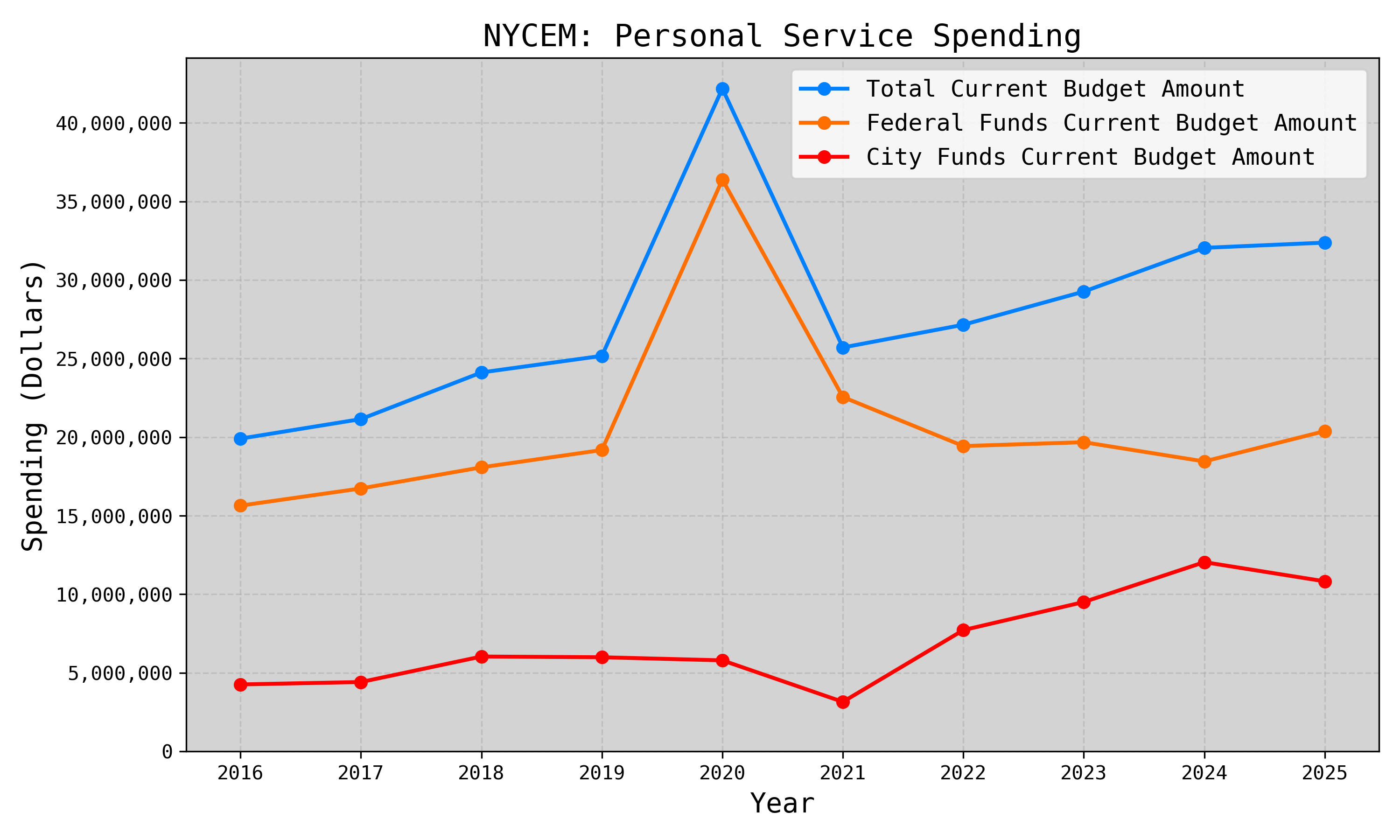
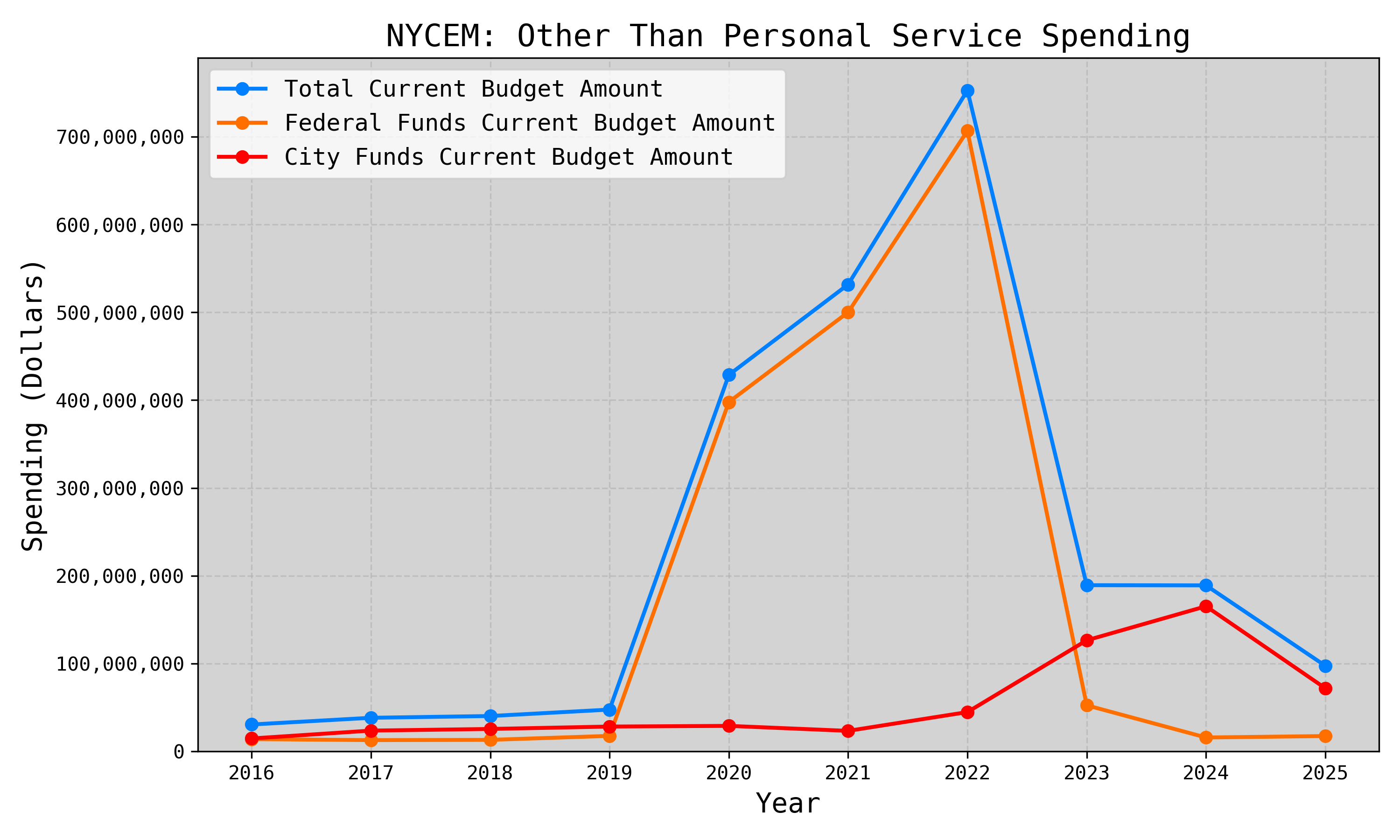
Most visually apparent is the enormous spike in federal funding OEM received from 2020-2022, which naturally coincides with the apex of the coronavirus pandemic. It is a staggering increase, with a nearly two-fold surge in PS spending, and a whopping twenty-five-fold surge in OTPS.
One clear insight we can gather is the degree to which federal spending on PS consistently outpaces the city’s in each fiscal year. In fact, more than half of NYCEM’s full-time positions are funded by the federal government. Don’t assume that this is entirely budgeted money. Many of these jobs — 125 in the aforementioned fiscal year — are paid for through Homeland Security grants like the Urban Area Security Initiative (UASI). These public servants address the kinds of threats Mr. Giuliani and Mr. Sheirer faced on that September morning in 2001: terrorism.
Recall that the current budget gives us the actual spending, and the adopted budget is inherently an estimate. When comparing adopted and current budget figures, the latter always outpaces the former.
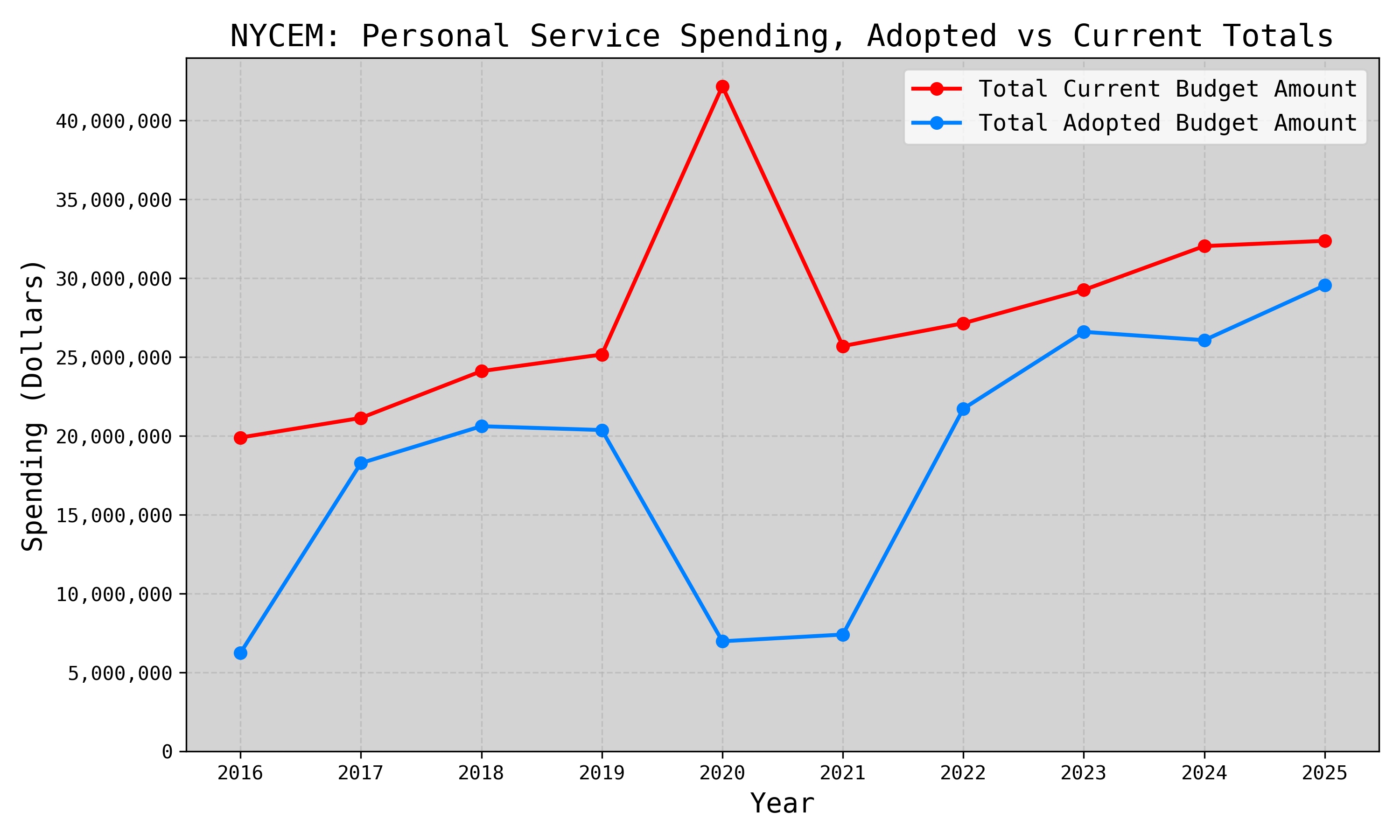
But when you decompose the comparison into their federal and city funding constituents, it’s evident that the contour of the total spending pattern is near-entirely driven by federal funding sources. Accordingly, one benefit that federal money confers is that these NYCEM positions are immune to city hiring freezes.
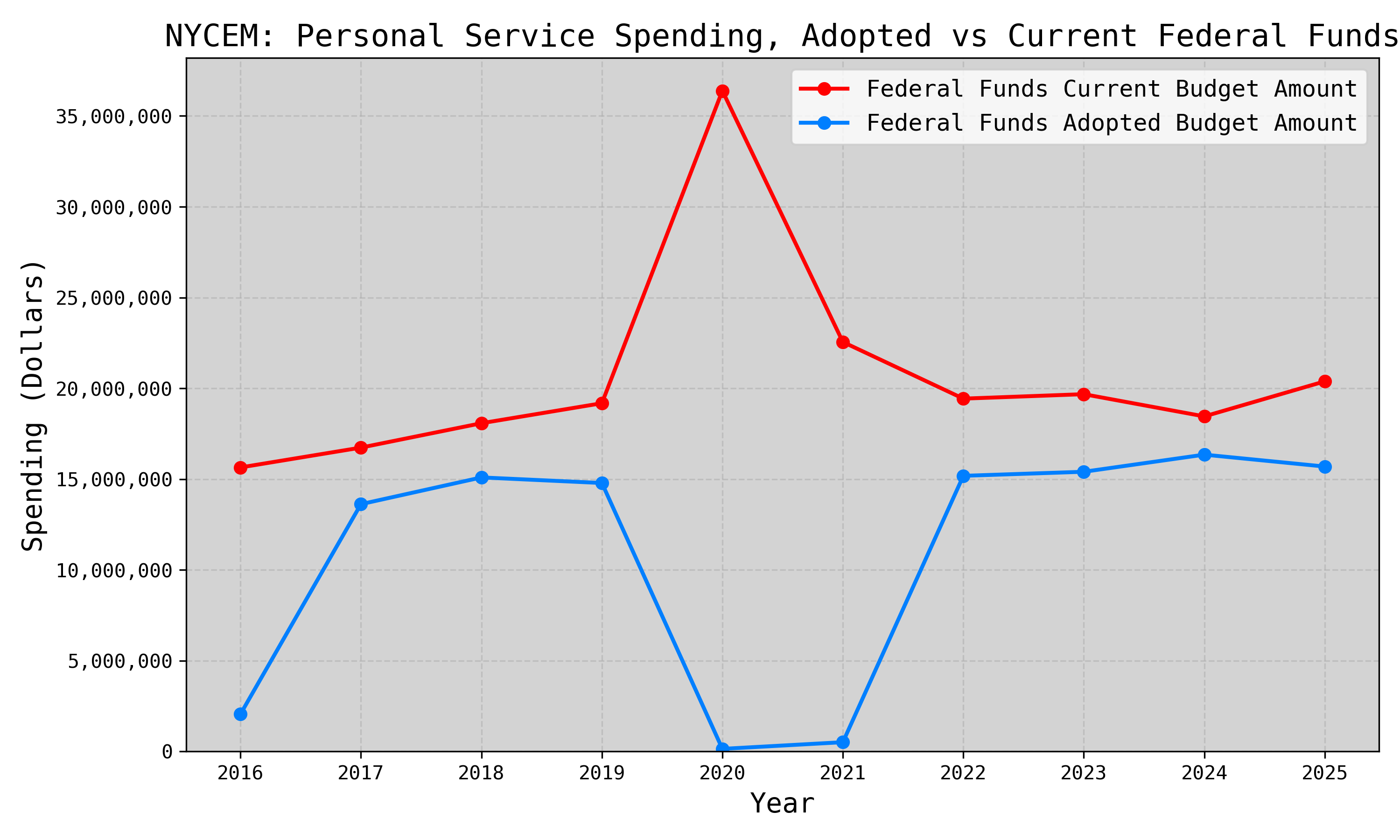
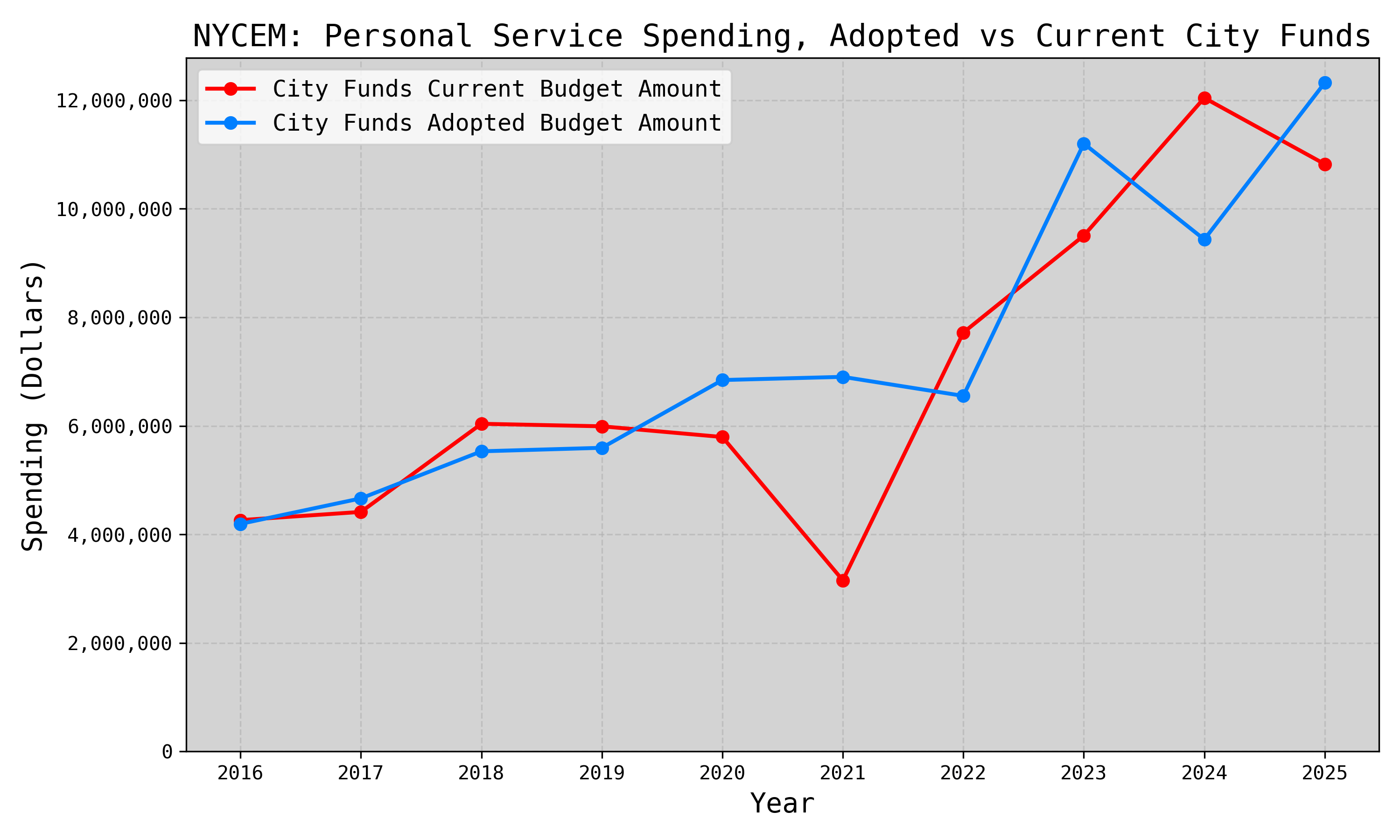
With respect to city funding, we can observe a general upward trend, with particularly steep increases throughout the 2020’s. Hikes in headcount here are attributed to the city delegating the response to the influx of asylum seekers to NYCEM.
All in all, we are illuminated by two insights:
NYCEM funding is substantially influenced by grantmaking by the Department of Homeland Security.
While the city has spearheaded personnel expansion in recent years, the highly politicized migrant crisis remains the primary driver.
That’s a wrap for Part I of this post, where my goal was purely descriptive: to simply explain the science of heat waves and the mechanics of how New York City finances and operates its emergency management agency.
For Part II, I’ll make the following normative argument, and argue for how we New Yorkers can lobby our political leadership to implement it:
As Mayor, Zohran Mamdani should bolster funding and agency capacity at the New York City Emergency Management office.
A parting gift to my readers: five sublime hours of 90’s aesthetic, retro Weather Channel Vaporwave.