

Author’s note I: Please do also read two of the event organizers, Henry Grunzweig’s and Tal Roded’s, reflections on the hackathon. And do subscribe to their Substacks, which I would order via executive fiat if I could. :-)
Author’s note II: I have a new tab on my Substack leading to my policy-related software projects, the first of which being Tideline, the subject of this article. You can access the projects hub here.
Author’s note III: Earlier today, Mayor Mamdani and City Council Speaker Menin conducted the handshake signifying the adoption of the City budget for fiscal year 2027. In a metaphorical sense, it is New York City government’s version of the College of Cardinals’ conclave in the selection of a new pope. It is also the final week leading up to the American Semiquincentennial, all of which is to say it is an extraordinary time to be alive and there is a great deal that I will strive to write about very soon.
Last week, I took part in the State Capacity and AI Hackathon hosted by the State Capacity Ecosystem Team. Alongside fantastic teammates Dean Berkowitz and Lyndsey Kaplan, our project emerged as one of two winners of the hackathon, and was ranked by two of the four judges as the best project.
Having been on both ends of many hackathons — as an organizer and participant — ranging from several hours to days, the State Capacity and AI Hackathon has the distinction of being the shortest event of its kind that I have attended. The time allocation for hacking, which in this context is a load-bearing word inclusive of ideation, product design, team-building, and pitch preparation (not to mention actual building), was constrained to two hours. Surprisingly, I found this format immensely liberating, as I much prefer the contest of concise focus to the contest of attrition that multi-day hackathons plod on to be. Practically speaking, a severely abridged time constraint also means that vibe coding is realistically the only way a working product can be delivered at the deadline. What distinguishes teams is taste, and knowing how to prompt code agents towards a user-intuitive product.
Before I explain the features of our project, however, a brief aside on the hackathon’s purpose — and why state capacity matters — is warranted.
What is state capacity?
There are many variations on the theme of state capacity, as evidenced by this comprehensive interface engineered by Henry Grunzweig, Tal Roded, and Jeremie Ponak. As for what state capacity is, Wikipedia is a fine place to start:
State capacity is the ability of a government to accomplish policy goals, either generally or in reference to specific aims. More narrowly, state capacity often refers to the ability of a state to collect taxes, enforce law and order, and provide services to the public.
In essence, state capacity is the concept of maximizing competence in government to accomplish the mandates under its remit. One (relatively) uncontroversial obligation of the state, for instance, is to guarantee the physical security of its citizens from all threats from within and without. Depending on your political bent, state capacity may entail the administrative will to provide a litany of subsidized entitlements like child care, health care, or tertiary education, the ability of governments to sufficiently provide legal engineering for markets that maximize aggregate growth and dynamism across the macroeconomy, or all of the above.
Whatever your disposition, it is indisputable that government needs talent, institutional sophistication, and legal empowerment to do good things. One element of state capacity is scalable and intuitive tooling for state bureaucrats to meet their constitutional and statutory obligations. Herein lies an invitation to all struck with a builder’s spirit, a calling to engineer the world towards an optimal state. State capacity is precisely that movement for the builders and tinkerers among us, seeking to create a More Perfect Union.
Tideline: a tool for climate capital planning
Our foray into this challenge last Wednesday culminated in engineering a proof of concept for better capital planning around flood mitigation, intended for fiscal policymakers in New York City. For our use case, we begin with the ubiquitous fact that New Yorkers have endured some type of calamitous weather event, be it extreme precipitation or heat or snowfall (the Winter of ‘26 is our discontent). It is probably not feasible to engineer weather, but it is tractable to reform the built environment and mitigate our collective exposure to these extraordinary events.
City policymakers are tasked under the Charter with formulating a budget for capital projects, defined by that document as physical public betterments classified as a capital asset under Generally Accepted Accounting Principles (GAAP).12 The New York City Independent Budget Office has a fantastic primer on the capital budget (submitted with the Mayor’s expense budget as part of the executive budget in April or May) and how to read the associated capital commitment plan, a triannual publication outlining the implementation schedule of capital projects for the current and following three fiscal years.
In the final year of former Mayor Eric Adams’ tenure, the Mayor’s Office of Management and Budget (OMB), the chief financial agency of the City and the entity charged with preparing the City’s numerous budget documents, began publishing an additional document: the New York City Climate Budgeting Report. There is no statutory or Charter requirement for the OMB to do this, and so far, it remains an executive initiative of the OMB’s Environmental Sustainability and Resiliency Taskforce that seems likely to continue under Mayor Zohran Mamdani. According to C40 Cities Climate Leadership Group, New York is the only American city that publishes a climate-specific budget.
That New York is a pioneer in municipal climate finance transparency is laudable, but for those who have actually opened the climate budget spreadsheet, its limitations are apparent: there is no associated geolocation data. It exists — albeit in a separate dataset called the Capital Projects Database published by the Department of City Planning (DCP). For connoisseurs of New York City Open Data or public servants familiar with the technical challenge of interagency data commensurability, one of the core bottlenecks in state capacity is the paucity of universal data standards or crosswalk schemas between analogous datasets published across different agencies. I alluded to this briefly in my oral and written testimony to the ongoing City Charter Revision Commission titled the Commission on Government Efficiency (COGE), but addressing the data commensurability problem will be a Herculean lift lasting well beyond the tenure of this Commission.
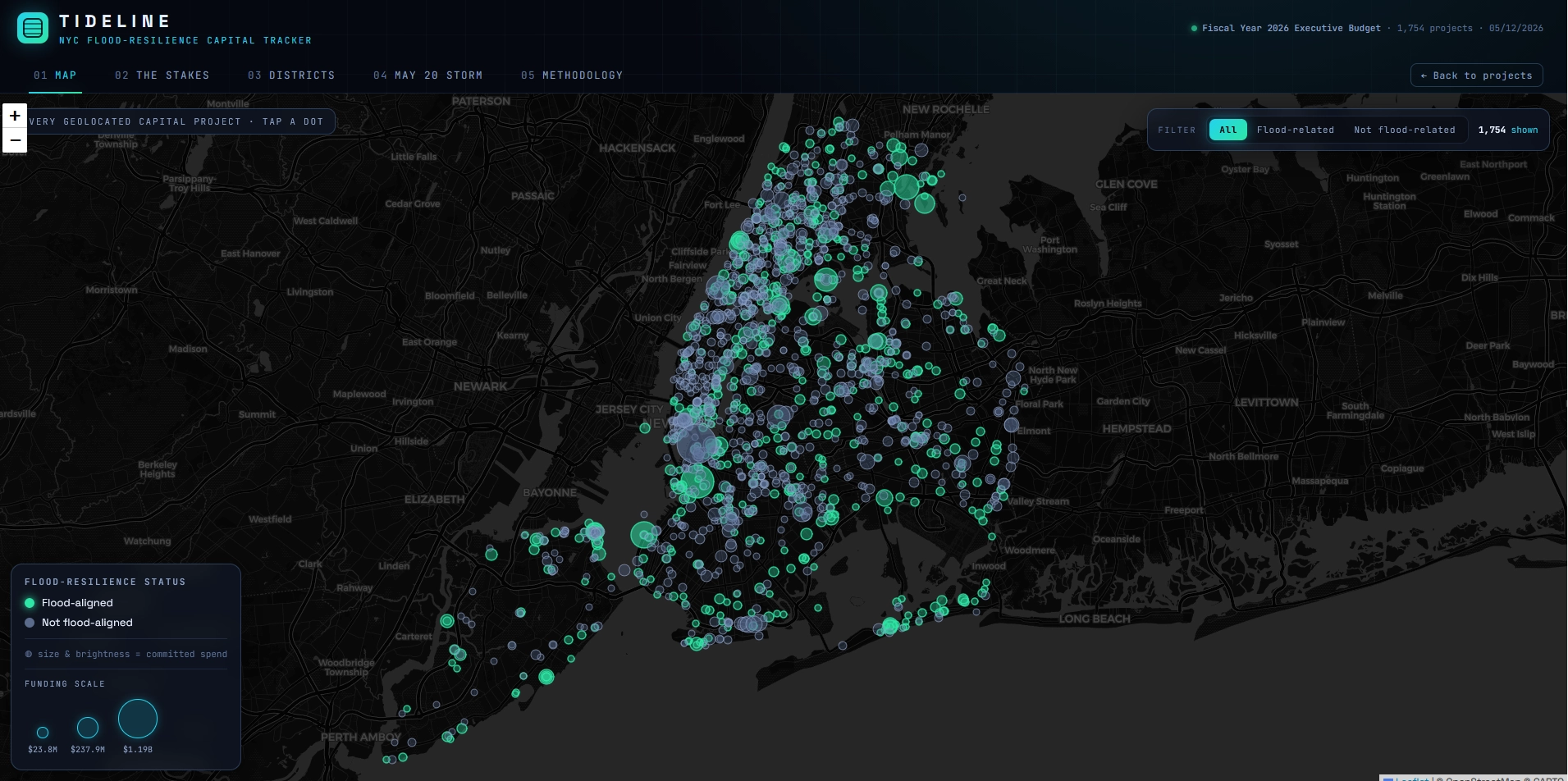
For the time being, we handled this at the hackathon with a simple Claude prompt to construct a crosswalk schema between the OMB and DCP documents, enabling us to build a map of flood-related capital projects across the five boroughs:
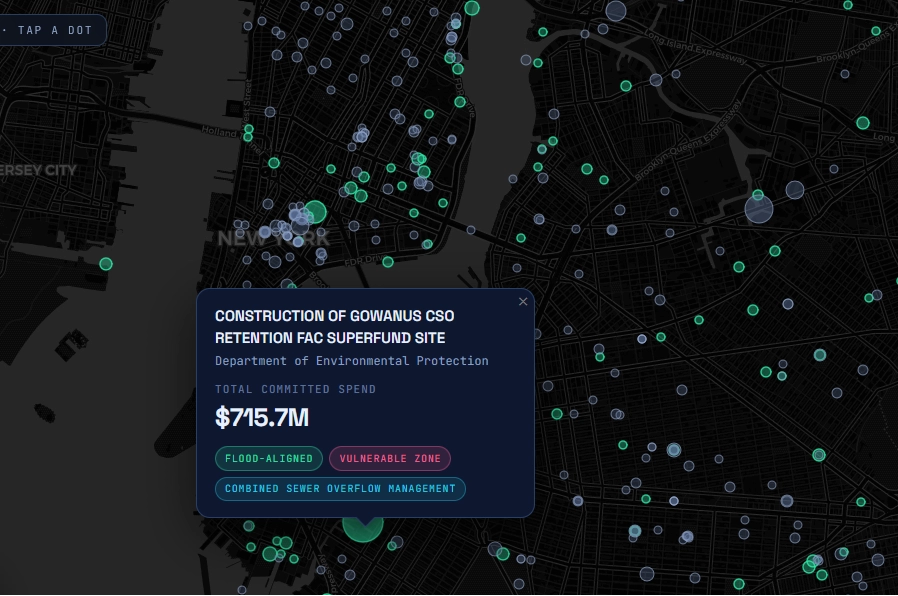
Using the climate budget, each dot on this map can be tapped to display the project specifics, its capital funding allocation, parent agency, and whether the project lies in a vulnerable flood zone:
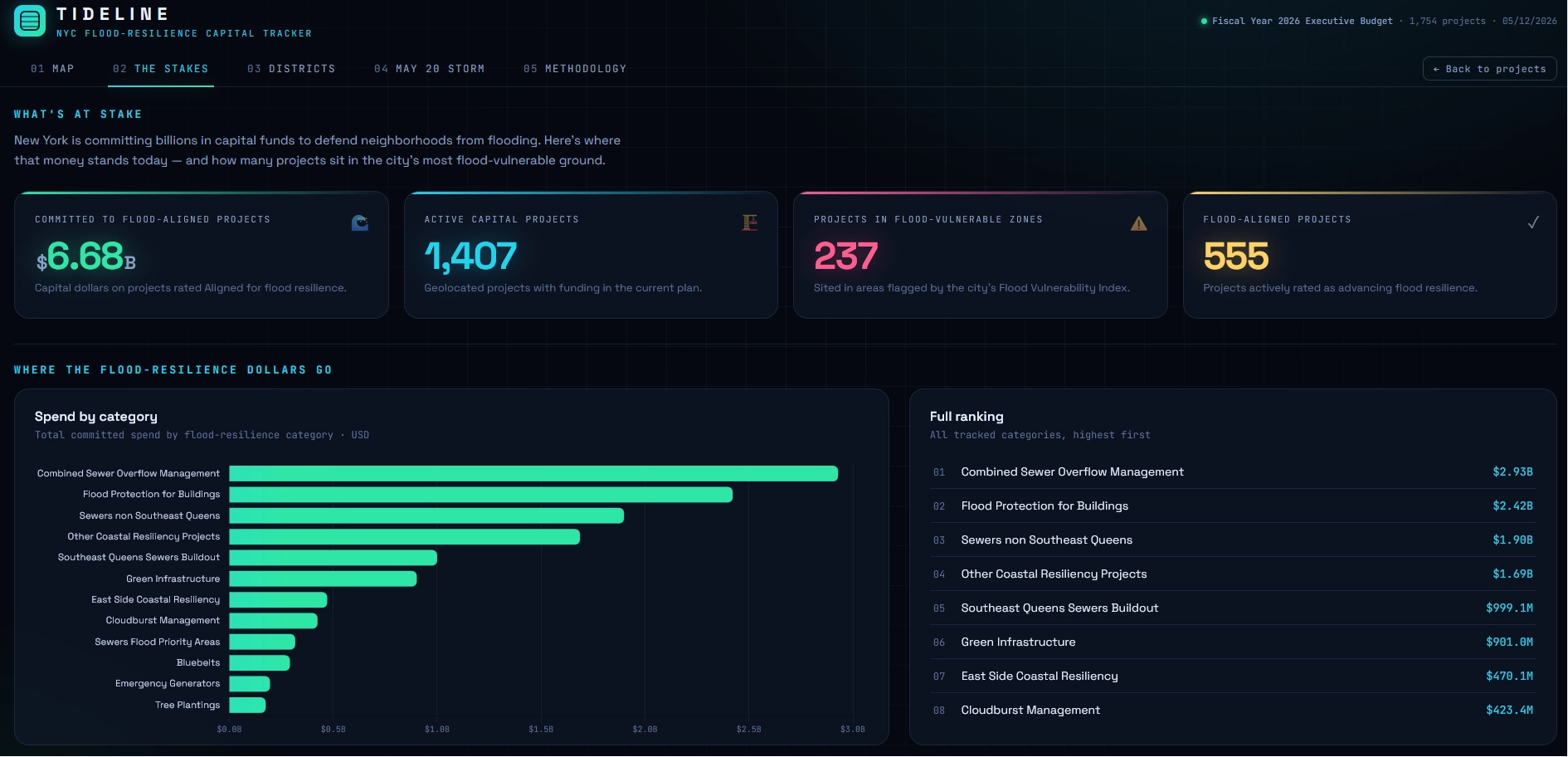
Tideline also calculates the sum of capital allocation to flood-aligned projects, the number of projects in the subset of the climate budget that pertain to flooding, and a breakdown of the distinct asset categories into which flood projects fall:
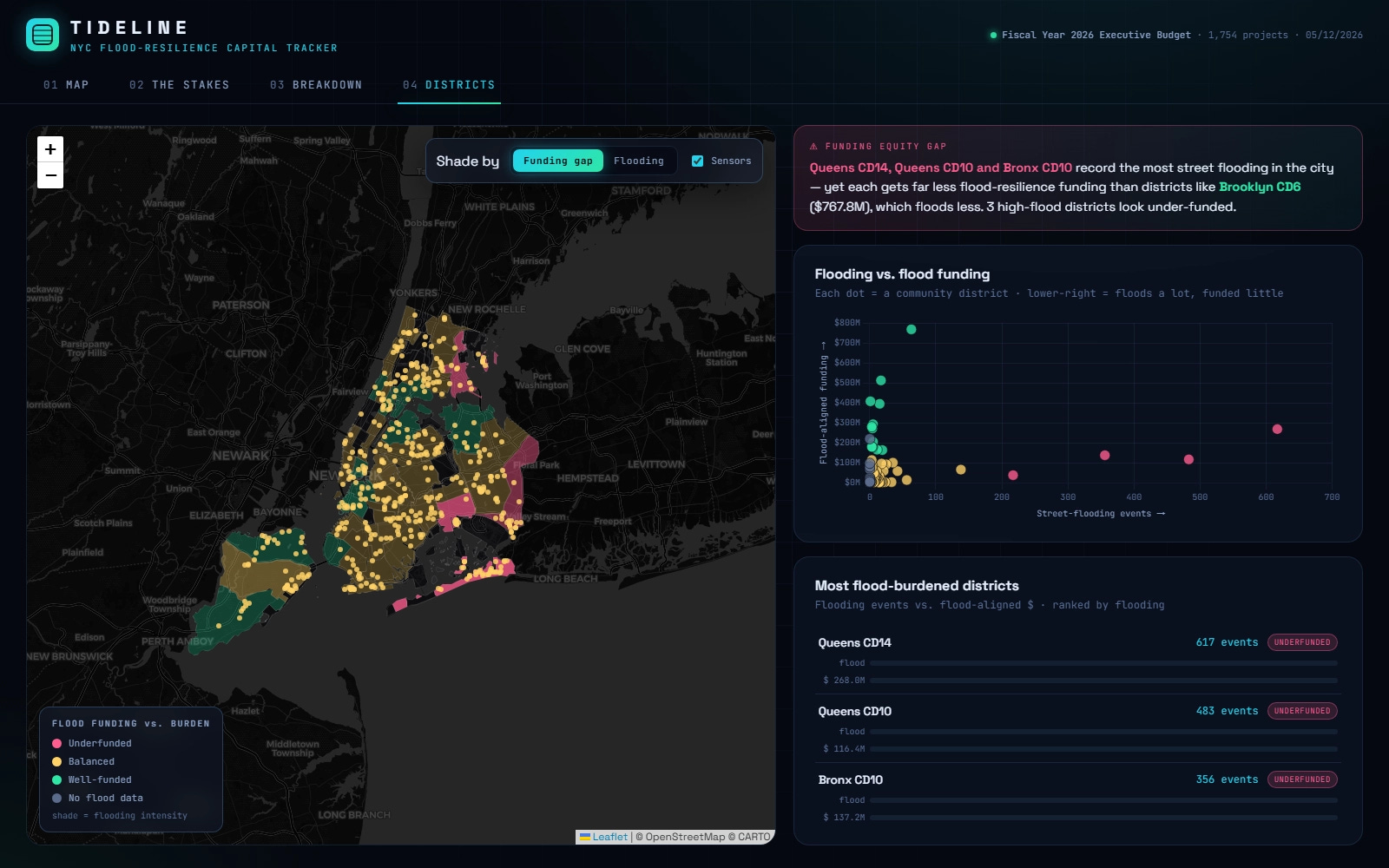
My favorite feature that we built, which tells a singular story across our City, is a map partitioned into the fifty-nine community districts of New York, populated with sensor locations from the FloodNet NYC project, and color-coded as a function of the capital funding each community district receives relative to the number of flooding events:
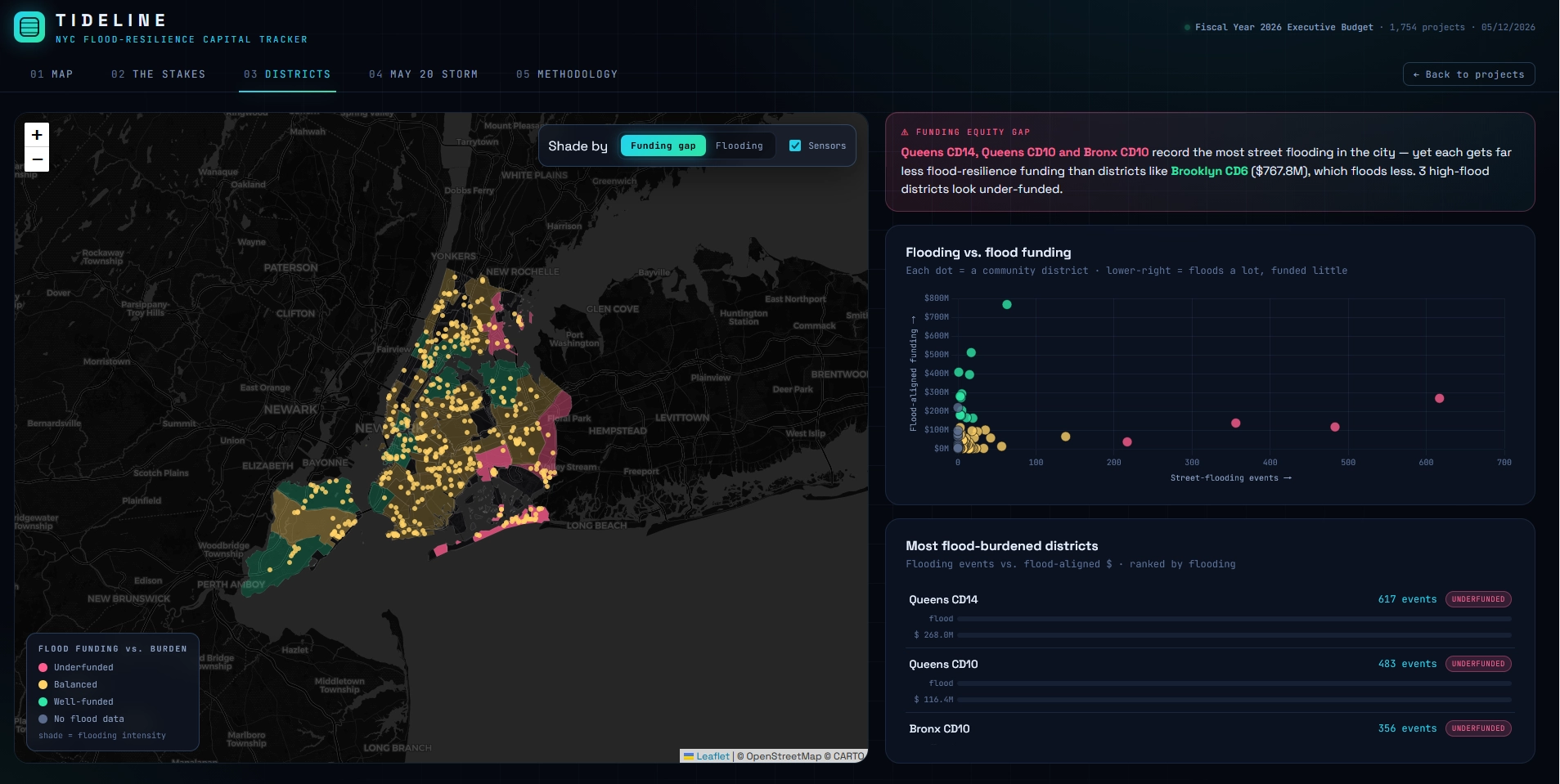
As is the case with many of our City’s funding priorities, neighborhoods in the far outer boroughs are disproportionately underfunded in relation to the number of flooding events they experience. You can read more about the methodology in calculating district-level flood burden here.
Lastly, the day after the hackathon, with a spirit newly invigorated by the boundless horizons of AI and state capacity-building, I added another feature overlaying animated FloodNet data from the precipitation event on May 20, 2026 with the static subway and bus geolocation data from the MTA’s General Transit Feed Specification (GTFS):
This represents only the planned transit schedules and not real-time data from May 20, which, to my knowledge, no MTA API exists to serve. Nevertheless, the animation demonstrates how mass precipitation events, even in localized areas of the City, can cause sprawling disruptions beyond the immediate area.
The endeavors driving the State Capacity and AI hackathon and my own program of unifying research efforts across the AI x climate and weather spaces and policymaking are harmonious and obligatory for making good on the paramount mandate of government: to mobilize its power to protect human life and property.
My aspiration is that those who clamor for sweeping state action on the extreme weather problem realize that righteous demands alone are insufficient. Effective governance on extreme weather requires efficient institutional design of the administrative state, replete with top-caliber talent and toolkits to address these massive challenges. As Joseph Heath puts it, we must not go straight to dessert without eating our vegetables, but we can strive to be as creative and bountiful in our grand dreams of statecraft as we would in preparing the ideal vegetable dish.
Once again, an enormous thanks to the State Capacity Ecosystem Team and to the hackathon judges: Dan Steinberg, Josh Seiden, Stephanie Yim, and Benjamin Kallos for their extraordinary efforts in organizing this event. Much of what goes into planning a hackathon of this scale is often an unseen and thankless effort, and everyone who contributed needs to be recognized for their titanic undertaking. Until next time!
Defined at § 210, broadly promulgated across § 211-222.
The funding mechanics for capital projects are substantially different than from the expense budget, which covers day-to-day operating expenses of city government and is financed through tax revenue. The capital budget is funded through bond issuance, primarily through general obligation (GO) bonds backed by the full faith and credit of the City. Other instruments exist by way of entities like the Transitional Finance Authority, which issues debt against personal income tax revenue. Bond issuance authority for New York City is derived not from the Charter, but from the State Local Finance Law and Article VIII of the State Constitution.
Such a pleasure having you and what an amazing tool!