
Welcome to my first full post of Alphabet Agency! As with all things in the creator economy, I have to be a writer AND a businessperson. That means I have to ask you to please subscribe if you like what you read!
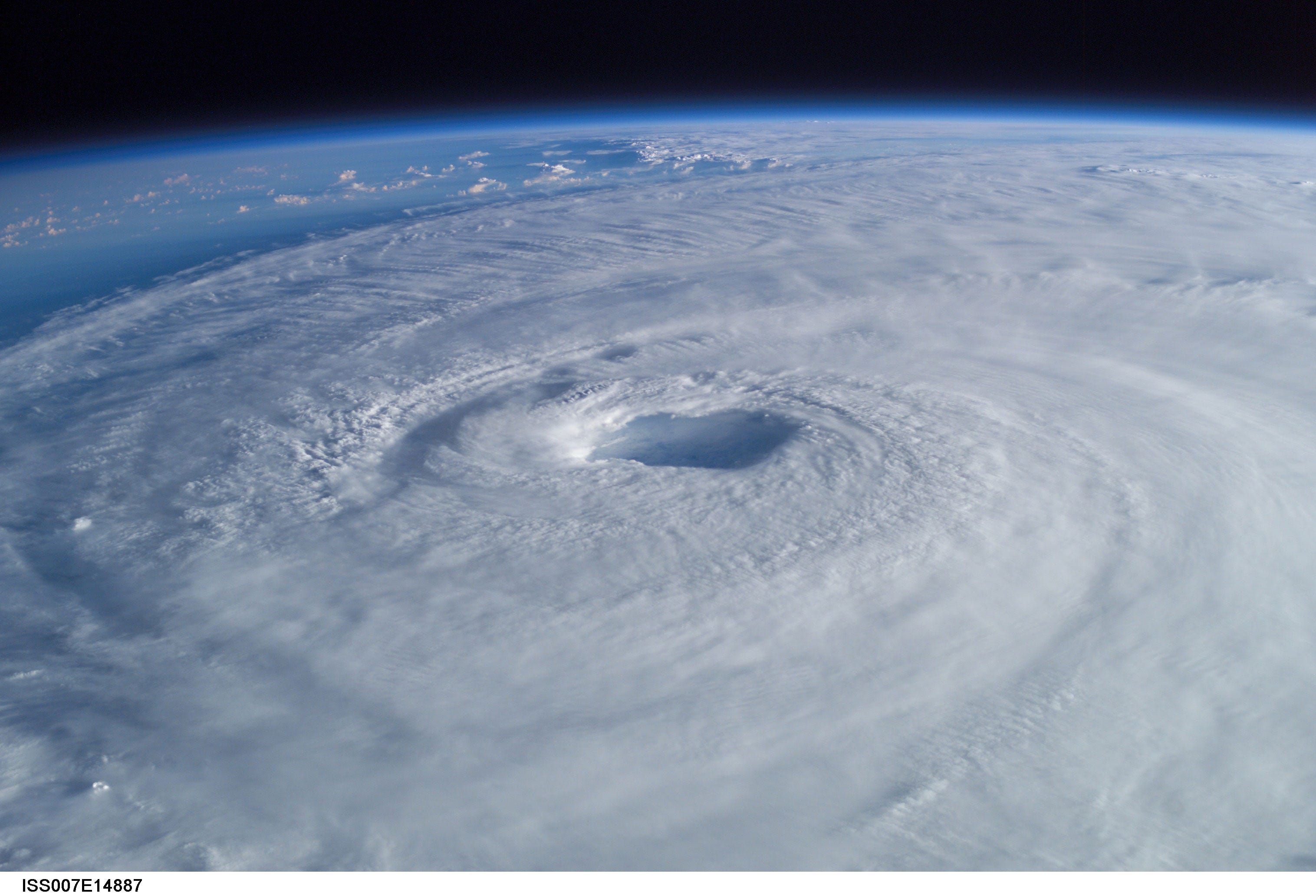
In the last year, I’ve invested a great deal of energy into getting involved in atmospheric and oceanographic research vis-à-vis the climate crisis. I also spend considerable time reading about international relations, so the natural question for me to pose: where does climate change fall into great power conflict?
If you haven’t seen the term before, great power conflict is what it sounds like: powerful nations engaged in competition with one another (for a myriad of reasons). Some, like John Mearsheimer, characterize great power competition as tragic. Collaboration between countries is inherently elusive, if not futile, and our modern existence in the system of nation-states is condemned to perpetual conflict.
This is too pessimistic of an outlook for me. Still, it behooves us to ask: how do societal stressors, such as climate change, disrupt the (relative) era of international peace largely upheld after the Second World War? Put differently, much has been written about the causal direction of geopolitics exacerbating climate change. Militaries consuming extraordinary quantities of fossil fuels and the like, or environmentally destructive tactics in warfare. What about the reverse direction: when climate change aggravates capital-g Geopolitics?
The “Struggle for Existence”
Nearly every invocation of the phrase “climate change” carries with it — rightfully — the threat of the end of humanity’s existence (and that of a plethora of other lifeforms in Earth’s biosphere). When I was more involved in community organizing in the late 2010’s, grassroots activists insisted on framing action on climate change as the moral equivalent of war, alluding to the late President Jimmy Carter’s 1977 speech on the energy crisis of that decade.
Now, climate action is far from the only collective endeavor routinely cast as a struggle for humanity’s future. Critically, geopolitics originates from a comparable framing.
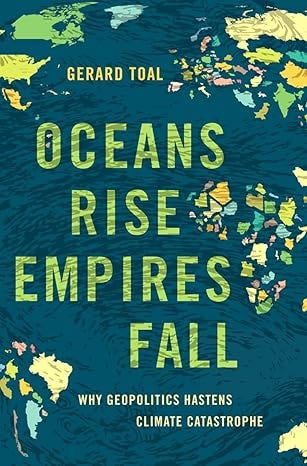
I recommend readers to check out Gerard Toal’s latest publication: Oceans Rise Empires Fall: Why Geopolitics Hastens Climate Catastrophe. Toal’s work served as one of the sources of inspiration for this piece, but more importantly, he weaves a compelling origin story for how the term “geopolitics” emerged to begin with.
Toal begins his account with the imperial geographers of the late 20th century: the likes of Halford Mackinder, a geographer, Tory parliamentarian, and advocate for Britain’s imperial ambitions. Akin to many of his contemporaries, Mackinder is not a likable individual, having subscribed to thoroughly racist notions of what the world order should constitute. Nevertheless, Mackinder’s theories on geopolitics have withstood to the present, and must be engaged for that reason.
Not unlike commentators of our time, Mackinder espoused a “great power” view of the world. Great powers are states — in his day, Britain, France, Germany, Russia, and the United States — that command the greatest influence on Earthly affairs. Be it through economic or military projection of might, we find similar formulations of the distribution of power today, most of all with the United States and China.
What are these great powers interested in? Mackinder’s words, in a school book no less:
The most important facts of contemporary political geography are the extent of the red patches of British dominion upon the map of the world, and the position of hostile customs frontiers. They are the cartographical expression of the eternal struggle for existence as it stands at the opening of the twentieth century.
Even in our political milieu, one might find these are chilling, even eschatological, apocalyptic words. Once again, British schoolchildren may have read these words a century ago. Certainly in our time, the vibes — and indeed, the truth — is that the stakes are dire, not only on climate change, but on the great power conflict our world is embroiled in. There is no denying that the two world-historic crises are interwoven.
Inaction on climate change is sure to beget horror. Although those who witnessed the horrors of the twentieth century are fewer in number with each day, our historical memory ought to know well the horrors that the epochal “struggle for existence” by empires begot in the twentieth century. As much as I and most others desire to see international collaboration on mitigating climate change, the sobering reality we must contend with is there was never, nor is, a guarantee for peaceful collaboration.
Which is not to say we foreclose on diplomacy to redress climate change. It is to be sober to the fact that we must mitigate not only the changing climate, but the very real potential of catastrophic warfare induced by climate change — prosecuted by the great powers of our day in the struggle for existence against the climate crisis.
The Risk Society
One compelling idea is German sociologist Ulrich Beck’s notion of the risk society. (Toal also invokes the thoughts of Beck frequently in his aforementioned text.) It’s a sufficiently big idea to warrant its own eponymous book, published in 1986. Beck’s idea here is not simply that bad things happen in the world and to society; that’s been (and will be) true for all time. It is that with the ever-evolving structures of organizing society, and our relationship with these structures, novel risks emerge — like anthropogenic climate change.
One structure of world society is that of the sovereign state, which collectively comprise the inter-national community of countries and institutions that mediate relations between these states. (For you international relations nerds, you know this as the Westphalian system, and it’s been with us since at least 1648.) In Beck’s framework of the risk society, modernizing forces such as industrialization impose profound transformations of the institutional and social relations by which people live and interact. In turn, these transformative and modernizing forces engender new risks, threatening to disrupt or even usurp the status quo of societal governance.
Okay, that’s our scaffolding for examining these ideas. Let’s look at some tangible studies.
Does extreme weather start wars?
The short answer: it’s an open question.
The better answer: Cullen Hendrix of the Peterson Institute for International Economics has a fascinating one. In a 2024 working paper with the PIIE, Hendrix examines the relationship between the El Niño Southern Oscillation, or ENSO, and global geopolitical risks. ENSO is the fluctuation of winds and sea surface temperatures (SSTs) over the equatorial Pacific Ocean, with many implications for global climate. It’s a topic of intense study by climate scientists, as ENSO is a fiendishly difficult physical phenomenon to predict.
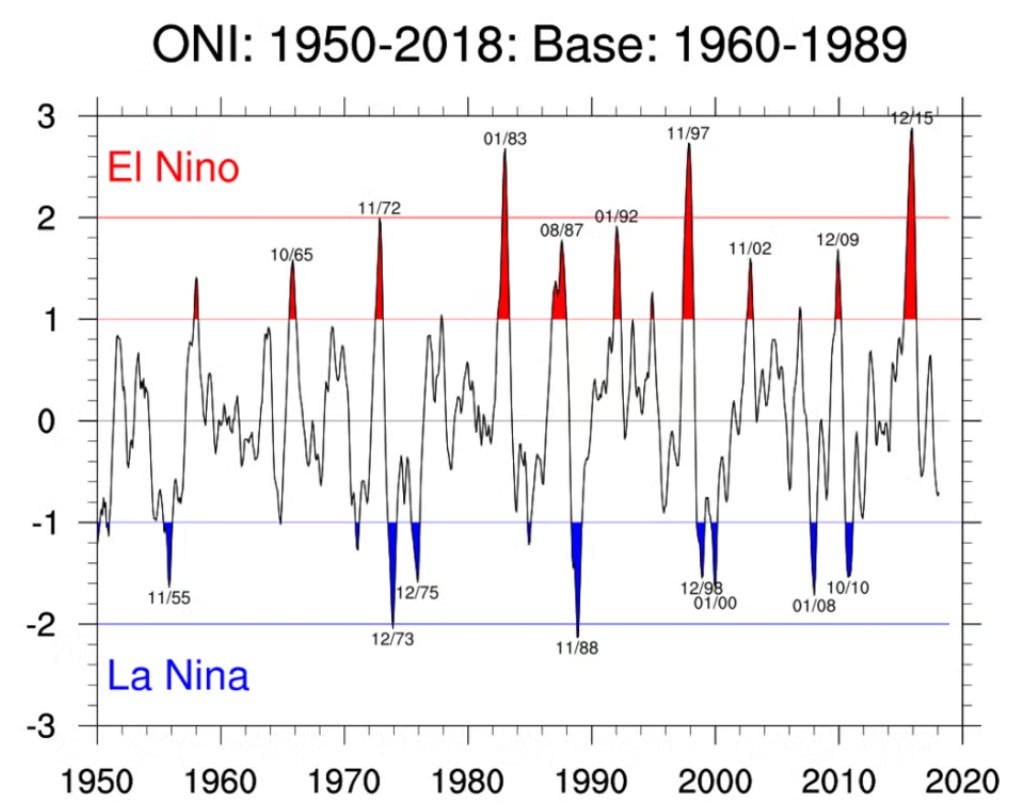
You’ve likely heard of El Niño and La Niña as distinct climate phenomena. The “oscillation” in ENSO refers to the phasal changes between El Niño and La Niña — when equatorial Pacific waters are warmer or cooler than average, respectively. One metric we have for determining the phase the Pacific is currently in is the Oceanic Niño Index (ONI). The vertical axis tells us how far away SSTs at a given time are away from the average over several decades.
(An aside: If you have some Python chops, or are inclined to get into quantitative climate modeling like the pros, the Climatematch Academy is a fantastic resource. The tutorials here will walk you through Xarray, the premier Python package for modeling weather and climate with high-dimensional data, and employing said data from the European Centre for Medium-Range Forecasting to do so.)
Back to geopolitics. The second index Hendrix examines is the Geopolitical Risk (GPR) Index by Dario Caldara and Matteo Iacoviello. The GPR is tabulated by analyzing an assortment of newspaper articles over the years, and identifying the relative frequency of topics pertaining to national security crises, such as the instigation of war, terrorist attacks, and military buildup. (I highly suggest checking out the authors’ presentation for details.)
Incorporating the two into several statistical models, Hendrix derives some fascinating results. These results, however, are sensible only when we ask how ENSO transmits its physical effects to specific geographic regions. For my earth scientist readers, you may have been wondering when I’ll bring up teleconnections, or relationships in regional weather patterns connected by large-scale climate dynamics. They are critically important for one simple question: which countries are most likely to be hit hardest by extreme ENSO phases?
Physically, teleconnections are very difficult to model. There’s a lot of heavy-duty mathematics involved. Nevertheless, Hendrix draws on existing research to pinpoint the top ten most probable countries with the strongest teleconnections — largely equatorial nations:
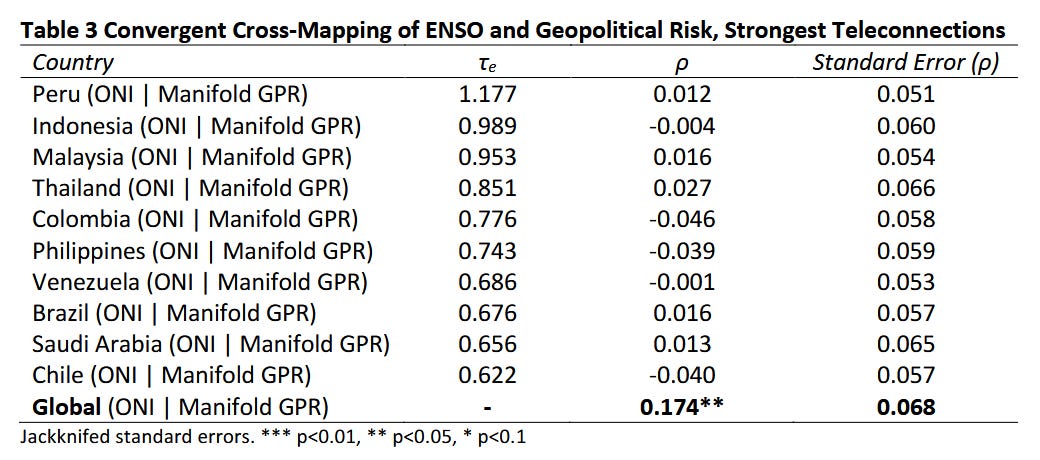
The second column corresponds to the strength of the teleconnection (the higher, the stronger), and the third is the correlation between ENSO effects and geopolitical risk. His specific choice of statistical model — convergent cross-mapping — is a tool of causal statistics, which endows these results with stronger merit for ENSO causing escalations in geopolitical risk than a merely correlative result.
That being said, the correlations for the countries with the strongest teleconnections aren’t terribly strong, which is quite an interesting result. By far the strongest and most statistically sound correlation is on the global scale. When plotting ONI values against the GPR, something intriguing happens: GPR tends to be most escalated during normal, non-extreme ENSO phases.
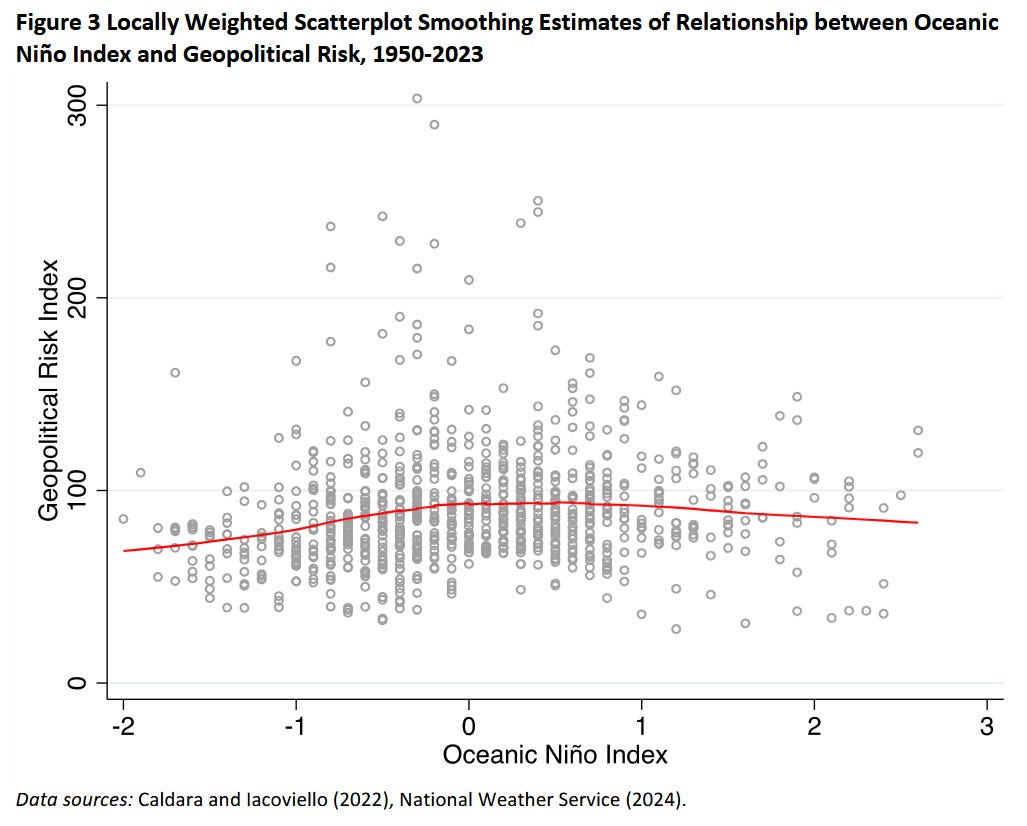
Hendrix offers the hypothesis that in periods of more extreme weather induced by El Niño, countries tend to focus inward on infrastructural resilience, rather than outward in broadsides of foreign aggression or sabre-rattling. Still, as Dale Copeland is wont to remind us, building statistical models to draw general relationships between causal factors of human conflict is fiendishly hard. Case studies (we will reclaim this phrase from the MBAs!) may be better suited. Another (co-authored) paper of Hendrix’s is more targeted, examining militarized fishing disputes in the East and South China Seas — instigated, in part, by ENSO.
Going through Hendrix’s oeuvre of research is going to be a priority of mine, as he’s one of few out there seriously investigating the climate → war direction of causality.
For now, do I believe that extreme weather can cause war? Uncertain, with much to learn, observe, and scrutinize. Regional conflict is one matter, but one persisting question will be how Ulrich Beck’s risk society of interdependent nation-states metamorphoses in a climate change scenario.
US-China Cold War 2.0: are we really fighting over weather?
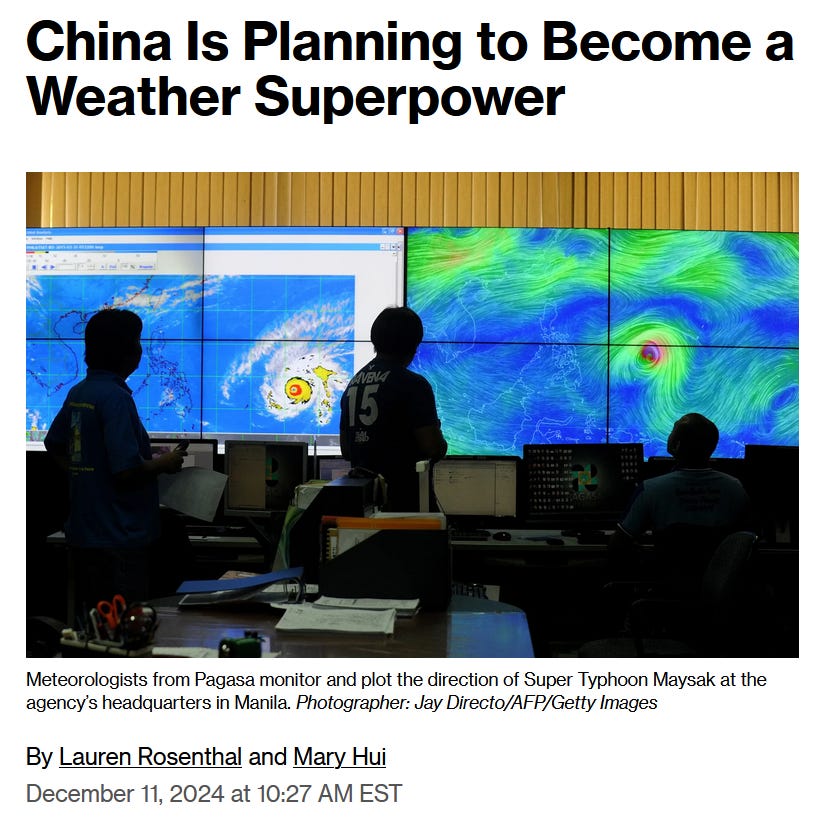
What I like about this is its meta-nature. Extreme weather is not only geopoliticized — its study and surveillance, by worldwide meteorological agencies, is too. Per Bloomberg, China has been surging its public expenditures to their national weather agency (the China Meteorological Administration, 中国气象局) for years. Meanwhile, President Trump and his Project 2025 ilk aspire to torpedo NOAA into smithereens.
Prima facie, it seems absurd that weather prediction would emerge as an arena of great power competition. But if you’ve been following technical trends in weather modeling, it makes sense (whether you agree with it or not).
Traditionally, agencies like NASA or NOAA employ enormously computationally-intensive models that simulate very complicated geophysical equations to model aggregate climate trends. In recent years, climate and machine learning scientists have been innovating on deploying AI to accomplish just-as-good, if not superior modeling, consuming far fewer compute to boot. Google’s GraphCast and Nvidia’s Earth-2 are leading contenders for the Americans. Huawei’s Pangu-Weather, for the Chinese.
AI modeling of weather and climate will near-certainly be a subset of the broader strokes of antipathy between the United States and China on AI, national security, and the extraordinary material supply chains (e.g. semiconductors) needed to uphold these national ambitions. The details of which, we are likely to see in due time.
Science is an international effort, transcending borders and the lassitude of foreign policy, until geopoliticians come knocking at the door.
What I want to read
I’d like to end these posts with books I come across my initial round of research, particularly those that either a) look promising for fleshing out incipient ideas, or b) address topics I hadn’t considered before. These will be more tangential than primary reads germane to the topic at hand, but nevertheless critical in my view to examine.
Two topics on my mind are: US-NATO policy in the Arctic, and mineral supply chain resiliency in the climate crisis. The simple explanation: as the Arctic polar ice melts, maritime passages in the extreme north open. This opens a Pandora’s box of national security dilemmas. On the latter, solar panels and wind turbines only get built after securing the requisite material inputs. What’s the thought process on that?
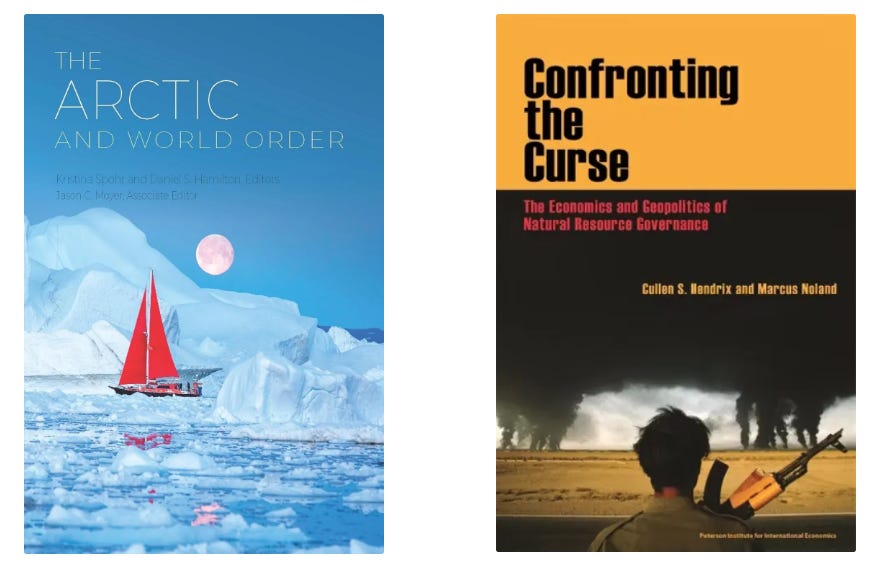
The Arctic and World Order, Kristina Spohr and Daniel S. Hamilton, Editors; Jason C. Moyer, Associate Editor
Confronting the Curse: The Economics and Geopolitics of Natural Resource Governance, Cullen S. Hendrix and Marcus Noland
That’s all for today, folks. If you’ve made it to the end, thanks so much for your time. I hope you took something away from this piece. Should you have, please consider subscribing and spreading the word!
-David